As a legal professional, your time is quite literally your most valuable asset. Every minute spent on a client’s case is a minute that deserves to be accurately recorded and properly compensated. However, the process of translating those meticulously logged billable hours into a clear, professional invoice can often feel like another time-consuming task in itself, detracting from the core legal work you need to do.
Navigating the nuances of client billing requires precision and transparency. Clients expect to see a detailed breakdown of services rendered, the time spent, and the associated costs, all presented in an easy-to-understand format. Without a standardized system, invoicing can become a source of confusion, errors, and even disputes, potentially harming client relationships and your firm’s financial health.
This is where a robust attorney billable hours invoice template becomes indispensable. It’s more than just a form; it’s a strategic tool designed to streamline your billing process, enhance professionalism, and ensure you get paid accurately and on time for the invaluable legal services you provide. Let’s explore how a well-crafted template can transform your firm’s financial operations.
The Core Elements of an Effective Attorney Billable Hours Invoice Template
Crafting an invoice that effectively communicates value and facilitates prompt payment is an art form, but one made significantly easier with a comprehensive template. An effective attorney billable hours invoice template isn’t just about listing numbers; it’s about providing a clear, auditable record of all work performed and expenses incurred, building trust and maintaining transparency with your clients.
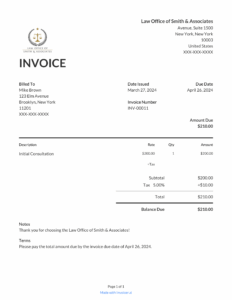
At its heart, any good legal invoice starts with clear identification. This means prominently displaying your law firm’s name, address, contact information, and any relevant license numbers. Equally important is the client’s information, including their full name and contact details, along with a specific matter or case reference number. This ensures that the invoice is directed to the right person and correctly associated with the specific legal work.
The backbone of an attorney billable hours invoice template is, of course, the detailed breakdown of services. This section needs to be meticulously organized, providing a line-by-line account of every billable activity. Each entry should clearly state the date the work was performed, a concise yet informative description of the task, the duration of the activity, and the hourly rate applied. This level of detail eliminates ambiguity and helps clients understand exactly what they are paying for.
For instance, simply stating “Research” is insufficient. A better entry would be “Legal research on contractual breach remedies for Acme Corp. v. Beta Inc. case.” This not only justifies the time spent but also reinforces the specific value you are adding to their legal matter. Consistency in how these entries are recorded across all invoices is key to maintaining a professional image and facilitating internal accounting.
Key Components to Include for Clarity
- Client and Matter Information: Full names, addresses, and unique case identifiers.
- Firm Details: Your firm’s name, logo, contact information, and relevant tax IDs.
- Invoice Number and Date: Unique identifier for tracking and the date of invoice generation.
- Detailed Time Entries: For each task: Date, Description of Service, Time Spent (in tenths of an hour), and Hourly Rate.
- Disbursements and Expenses: Itemized list of out-of-pocket costs (filing fees, travel, printing, etc.) with receipts if applicable.
- Total Amount Due: The sum of all billable hours and expenses.
- Payment Terms and Due Date: Clear instructions on how and when payment is expected.
- Trust Account Information (if applicable): Details for payments into client trust accounts.
Beyond billable hours, an effective invoice must also account for any disbursements or expenses incurred on behalf of the client. These typically include court filing fees, deposition costs, travel expenses, printing charges, and expert witness fees. Each of these items should be listed separately, often with an accompanying receipt or clear explanation, ensuring the client understands these additional costs are directly related to their case, not part of your hourly rate.
Finally, the invoice needs to clearly state the total amount due, along with explicit payment terms. This includes the due date, acceptable payment methods, and any late payment policies. A professional attorney billable hours invoice template will incorporate all these elements seamlessly, making the billing process straightforward for both you and your client.
Streamlining Your Billing Process with a Template
The adoption of a well-designed attorney billable hours invoice template can significantly enhance the operational efficiency of any legal practice, regardless of its size. Think about the time currently spent formatting invoices from scratch, ensuring all necessary details are included, and double-checking calculations. A template eliminates much of this repetitive work, freeing up valuable administrative and legal staff hours that can be redirected to more substantive tasks.
One of the most compelling benefits of using a template is the consistency it brings to your billing practices. Every invoice sent out will share a uniform look and structure, reinforcing your firm’s professional brand identity. This consistency also minimizes the risk of inadvertently omitting crucial information, such as specific case numbers, payment terms, or detailed service descriptions, which are essential for accurate record-keeping and avoiding client queries.
Furthermore, a standardized template dramatically reduces the potential for errors. When you have pre-defined fields for dates, descriptions, hours, and rates, the chance of miscalculating totals or entering incorrect information decreases substantially. This accuracy is paramount not only for your firm’s financial integrity but also for maintaining client trust. Clients are more likely to pay promptly when they perceive the invoice to be transparent and correct.
Using an attorney billable hours invoice template also simplifies financial tracking and reporting. With a consistent format, your accounting department or software can more easily process invoices, track payments, and generate financial reports. This makes month-end reconciliation less of a chore and provides a clearer picture of your firm’s revenue streams and outstanding receivables, aiding in better financial management and forecasting.
A robust template can be adapted to fit various client needs or specific matter types. Whether you bill hourly, on a fixed-fee basis, or use a hybrid model, a flexible template can be customized to reflect these arrangements without starting from square one. This adaptability ensures that your billing process remains efficient and tailored, no matter the complexity of the legal work or the client agreement.
Embracing a well-structured billing approach is a strategic move for any law firm. It not only simplifies the administrative burden but also elevates the client experience by providing clarity and professionalism in every transaction. Investing time upfront in selecting or creating a robust attorney billable hours invoice template pays dividends through improved efficiency, enhanced client relations, and a stronger financial foundation for your legal practice.
By prioritizing clear, consistent, and accurate billing through a standardized system, legal professionals can ensure they are properly compensated for their expertise while fostering strong, trusting relationships with their clients. A thoughtful approach to invoicing is not just about getting paid; it is about reflecting the high standards of your legal services.