Navigating the financial side of a law practice can often feel like a complex legal brief in itself. Beyond the demanding work of representing clients, ensuring timely and accurate billing is fundamental to maintaining a healthy and sustainable business. Many firms find themselves wrestling with inconsistent methods, leading to confusion for both their team and their clients.
A well-structured billing process isn’t just about getting paid; it’s about clarity, professionalism, and building trust. When clients receive an invoice that is easy to understand, transparent about charges, and professionally presented, it reinforces their confidence in your firm’s operations and integrity. Conversely, a jumbled or unclear bill can lead to disputes and unnecessary administrative overhead.
This is where a dedicated law firm billing invoice template becomes an invaluable asset. It standardizes your billing procedures, reduces errors, and ensures that all essential information is consistently communicated. By streamlining this critical administrative task, you free up valuable time that can be better spent focusing on your clients and legal work.
Why a Specialized Invoice Template is Crucial for Law Firms
The unique nature of legal services demands a billing approach that goes beyond generic invoicing. Unlike product-based businesses, law firms often deal with intricate time tracking, varying hourly rates for different professionals, flat fees for specific services, contingency arrangements, and the careful management of retainers and disbursements. A standard business invoice simply isn’t equipped to handle these complexities with the necessary detail and compliance.
A specialized law firm billing invoice template addresses these unique challenges head-on. It provides structured fields for capturing every detail, from specific tasks performed and the time spent on each, to the individual attorney or paralegal responsible. This level of granularity is not only crucial for internal record-keeping but also for satisfying client inquiries and demonstrating transparency, especially in cases where fees might be reviewed by a court or opposing counsel.
Furthermore, a professionally designed template upholds your firm’s image. It shows clients that you are meticulous in all aspects of your practice, including your administrative duties. An organized, easy-to-read invoice fosters confidence and reduces the likelihood of billing questions or payment delays, ultimately improving your cash flow and client relationships. It’s an extension of your brand, reflecting the same attention to detail you apply to legal matters.
Consistency across all invoices is another significant benefit. Without a template, different staff members might use varying formats or omit crucial information, leading to discrepancies. A uniform template ensures that every bill sent out meets your firm’s standards, maintains compliance with ethical obligations regarding billing, and simplifies reconciliation for your accounting department.
Key Elements Every Law Firm Invoice Should Include
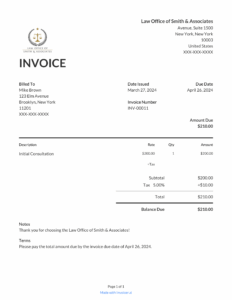
To be truly effective, a law firm billing invoice template must incorporate several critical pieces of information. These elements ensure clarity, compliance, and ease of payment for your clients. Neglecting any of these could lead to confusion or challenges down the line.
- Full contact information for your law firm, including name, address, phone number, and email.
- Complete client contact details, including their name, address, and any relevant client matter numbers.
- A unique invoice number and the date of issue for easy tracking.
- The dates of services rendered, clearly indicating the period covered by the invoice.
- A detailed breakdown of services or tasks performed, including a description of the work, the date it was completed, the attorney or staff member who performed it, and the time spent (if applicable).
- Applicable hourly rates for each professional involved.
- A clear itemization of disbursements and expenses incurred on the client’s behalf, such as court filing fees, travel costs, or research fees.
- Any trust account activity, showing initial retainers, funds applied, and the current trust balance.
- The total amount due, including subtotals for fees and expenses.
- Clearly stated payment terms, including the due date and acceptable payment methods.
- Your firm’s payment instructions, such as bank transfer details or links to online payment portals.
Ensuring these components are consistently present and clearly presented within your law firm billing invoice template will significantly enhance your firm’s financial operations and client satisfaction.
Finding and Customizing Your Ideal Template
Once you recognize the indispensable value of a dedicated billing template, the next step is finding one that perfectly suits your firm’s needs. Many resources are available, from basic downloadable spreadsheet templates to integrated features within legal practice management software. The key is to select a foundation that allows for full customization to reflect your firm’s unique identity and operational nuances.
Begin by exploring options that align with your firm’s size and billing volume. Smaller firms might find a robust Excel or Google Sheets template sufficient, offering flexibility for manual entry and basic calculations. Larger firms or those with complex billing models might benefit more from templates embedded within specialized legal software, which can automate time tracking, expense logging, and invoice generation, drastically reducing administrative burden.
Consider your specific practice areas and fee structures. A firm primarily handling personal injury cases on a contingency basis will need a different template focus than one specializing in corporate law with hourly billing. The template should be adaptable to whether you charge hourly, flat fees, retainers, or a combination. Think about how easily you can modify fields, add categories, or adjust the layout to fit these diverse requirements without starting from scratch.
When customizing, pay close attention to your firm’s branding. Incorporating your logo, firm colors, and specific fonts creates a professional and cohesive look that reinforces your brand identity with every communication. Also, ensure the language used in the template is clear, concise, and easy for clients to understand. Avoid overly technical jargon where plain language will suffice, especially when describing services or expenses.
Don’t forget to include any specific legal disclaimers or jurisdictional requirements that might be necessary for your invoices. This foresight can prevent potential issues and ensure full compliance. A thoughtfully customized template streamlines the entire billing process, from creation to collection, and ultimately supports your firm’s financial health and reputation.
Adopting a specialized and well-crafted billing template is more than just an administrative upgrade; it’s a strategic decision that reflects a commitment to efficiency and transparency. It empowers your firm to present its financial dealings with the same professionalism and meticulousness applied to every legal case. This careful attention to detail not only ensures accurate accounting and steady cash flow but also strengthens the trust and confidence your clients place in your services.
Ultimately, a streamlined and transparent billing system, anchored by a robust template, becomes a cornerstone of a well-managed law practice. It frees up your valuable time, minimizes disputes, and allows your team to focus on what they do best: providing exceptional legal counsel. This quiet efficiency behind the scenes contributes significantly to client satisfaction and the sustained growth of your firm.