Applying for a PhD can feel like navigating a complex maze, and among all the documents you need to prepare, the cover letter often stands out as a critical piece. It’s your chance to make a strong first impression, to introduce yourself beyond the bullet points of your CV, and to articulate your passion and fit for a specific program or supervisor. Finding a solid cover letter template for PhD application can really help you structure your thoughts and ensure you include all the essential details.
Think of your cover letter as your personal advocate, speaking directly to the admissions committee or potential supervisor. It’s where you connect the dots between your past experiences, your future aspirations, and the unique opportunities offered by their institution or research group. This isn’t just a formality; it’s an opportunity to show your personality, your critical thinking, and your genuine enthusiasm for advanced research.
In the following sections, we will explore what makes an exceptional PhD cover letter and provide a practical framework to help you craft a compelling narrative that highlights your strengths and aligns perfectly with your desired program. Let’s dive into how you can transform a daunting task into a strategic step towards your academic goals.
Crafting Your PhD Cover Letter: Beyond Just a Formal Introduction
Your PhD cover letter is much more than a summary of your CV; it’s a persuasive essay designed to convince the reader that you are not only qualified but also an ideal candidate for their specific program and research environment. This document allows you to weave a narrative, connecting your academic journey, research experience, and future aspirations in a coherent and compelling way. It’s your opportunity to showcase critical thinking, initiative, and a deep understanding of the research area you wish to pursue.
One of the most important aspects is to demonstrate a clear alignment between your interests and the research conducted at the institution or by the specific professor you are targeting. This requires thorough research on your part. Don’t just mention the university; discuss specific projects, publications, or research groups that genuinely excite you. This level of detail shows sincerity and that you haven’t just sent out a generic application. It proves you’ve done your homework and are truly invested in *their* work.
Moreover, highlight your unique skills and experiences that are relevant to a PhD program. This could include specific laboratory techniques you’ve mastered, statistical software proficiency, experience with data analysis, or a history of independent research projects. Quantify your achievements whenever possible. Instead of saying “I have research experience,” say “I successfully completed a research project on X, resulting in Y, and presented my findings at Z conference.” This gives concrete evidence of your capabilities.
Express your motivation for pursuing a PhD. What drives you to undertake such an intensive and demanding academic journey? Share your intellectual curiosity, your desire to contribute new knowledge to your field, or your long-term career goals that necessitate a doctoral degree. This personal touch helps the reader connect with your ambition and dedication, making your application more memorable amidst a sea of qualified candidates.
Furthermore, articulate how your previous academic and professional experiences have prepared you for the rigors of doctoral research. Did you overcome significant challenges in your undergraduate or master’s studies? Did you develop resilience, problem-solving skills, or a strong work ethic? These are all valuable attributes for a PhD student, and your cover letter is the perfect place to subtly highlight them.
Remember, clarity and conciseness are paramount. While you have a lot to say, admissions committees and professors are busy. Each paragraph should have a clear purpose and contribute to your overall argument. Avoid jargon where simpler language suffices, but don’t shy away from demonstrating your familiarity with technical terms relevant to your field. Ultimately, your cover letter should paint a picture of a thoughtful, prepared, and enthusiastic prospective researcher ready to make significant contributions.
A Practical Cover Letter Template for PhD Applications: What to Include
While every cover letter should be unique to the applicant and the program, having a strong structure can make the writing process much smoother. Think of a template not as a rigid script but as a helpful skeleton that ensures you hit all the necessary points. It provides a logical flow, guiding the reader through your qualifications and enthusiasm without missing crucial information.
The essential sections of a PhD cover letter are fairly standard, but it’s the content within these sections that allows your individuality to shine through. From your contact information to your closing remarks, each part serves a distinct purpose in presenting you as a strong and suitable candidate. This structure helps you build a coherent and persuasive argument for your admission.
Remember that this template is a starting point. Always tailor each section to the specific university, department, and potential supervisor. Generic cover letters are rarely successful because they fail to demonstrate the applicant’s genuine interest and specific fit. Your goal is to show that you’ve put thought and effort into this particular application.
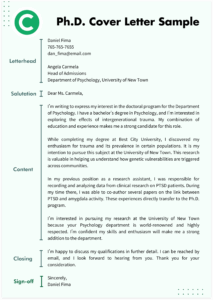
Here’s a breakdown of the key elements you should include in your cover letter:
* Your Contact Information (Name, Address, Phone, Email)
* Date
* Recipient’s Contact Information (Name, Title, Department, University, Address)
* Salutation (e g Dear Dr Last Name or Dear Admissions Committee)
* Opening Paragraph
* State the position you are applying for (e g PhD program in X)
* Mention how you learned about the program
* Briefly state your primary research interest or area of expertise
* Express your enthusiasm for the program and the institution
* Body Paragraphs (typically 2-4)
* Elaborate on your academic background and relevant coursework
* Detail your research experience, projects, publications, or presentations
* Highlight specific skills (e g lab techniques, statistical software, language proficiency)
* Explain why you are interested in this particular program or specific faculty member’s research
* Discuss how your background aligns with their research and how you can contribute
* Mention any relevant professional experience or leadership roles
* Concluding Paragraph
* Reiterate your strong interest and enthusiasm
* Briefly summarize why you are an ideal candidate
* Express your eagerness for an interview or further discussion
* Thank them for their time and consideration
* Professional Closing (e g Sincerely, Best Regards)
* Your Typed Name
* Your Signature (if submitting a physical copy)
Taking the time to craft a thoughtful and personalized cover letter can significantly enhance your PhD application. It’s your opportunity to show the admissions committee not just what you’ve done, but who you are as a budding researcher and why you are a perfect fit for their academic community. A well-written letter can truly set you apart in a competitive application pool.
Ultimately, your cover letter is an indispensable tool in conveying your passion, preparedness, and potential. By following a structured approach and infusing your unique voice and experiences, you can create a document that powerfully advocates for your admission. It’s an investment of time that can yield significant returns, paving the way for your advanced studies and future contributions to your field.