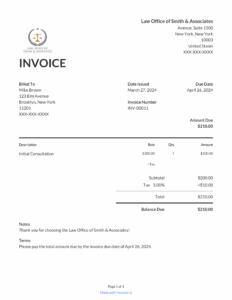
In the intricate world of legal practice, managing your finances effectively is just as crucial as winning cases for your clients. A key component of this financial management is your invoicing process. It is the bridge between your hard work and timely compensation, and it also plays a significant role in how your clients perceive your professionalism and the value you provide. A clear, comprehensive, and easy-to-understand invoice is not merely a request for payment; it is a statement of transparency and an essential part of maintaining a strong client relationship.
However, crafting detailed invoices from scratch for every single client and every unique case can quickly become a time-consuming and often repetitive task. This manual effort not only eats into valuable billable hours but also increases the potential for errors, leading to confusion, delays in payment, and even strained client relationships. Discrepancies, no matter how small, can erode trust and complicate the financial aspect of legal services.
This is where the power of a dedicated law firm legal invoice template comes into play. By utilizing a standardized yet flexible template, you can streamline your billing procedures, ensure consistency across all your client communications, and present a polished, professional image every time. It’s about working smarter, not harder, to keep your practice financially healthy and your clients informed.
What Makes a Great Law Firm Legal Invoice Template?
A truly effective law firm legal invoice template is far more than just a blank document with a few lines for numbers. It is a carefully structured tool designed to communicate comprehensive billing information clearly and concisely, adhering to both professional standards and legal best practices. The best templates anticipate what information a client needs to see, what details your firm needs to track, and what regulatory requirements must be met, all while being easy to fill out and understand.
At its core, a robust invoice template begins with clear identification. You need to prominently display your law firm’s name, address, and contact information, ensuring clients know exactly who they are paying. Equally important is accurately identifying the client and the specific legal matter. This often includes the client’s full name, their address, and a unique matter identification number, which helps prevent any confusion when a client has multiple ongoing cases or when managing various entities.
Key Details for Client and Firm Identification
- Your Law Firm’s Full Name, Address, and Contact Information
- Client’s Full Name, Address, and Relevant Contact Details
- Unique Case or Matter Identification Number
- Invoice Number and Date of Issue
Beyond basic identification, the heart of any legal invoice lies in its detailed breakdown of services rendered. This is where transparency truly shines. Each service item should include the date it was performed, a clear description of the work, the time spent on that specific task, and the applicable hourly rate. For example, instead of a vague “Legal Services,” you might specify “Drafting motion for summary judgment,” “Court appearance for status conference,” or “Client consultation regarding settlement offer.” This level of detail helps clients understand exactly what they are being billed for and reinforces the value of your work.
Itemizing Your Legal Services Accurately
- Date of Service
- Detailed Description of the Legal Work Performed
- Time Billed (in hours or fractions thereof)
- Applicable Hourly Rate for the Service Provider
- Individual Line Item Total
Furthermore, a comprehensive template must account for expenses and disbursements. These are the costs incurred on behalf of the client that are separate from your professional fees, such as court filing fees, deposition costs, travel expenses, research subscriptions, or third-party expert fees. These should be listed separately from your services, often with an accompanying receipt or explanation, to maintain clarity and avoid any ambiguity. It ensures clients understand these are pass-through costs, not part of your professional fee structure.
Finally, the template must clearly present the financial summary. This includes the subtotal for services, the subtotal for expenses, any applicable taxes, and the grand total amount due. Crucially, it must also outline the payment terms, including the due date, acceptable payment methods, and any policies regarding late payments or interest charges. Clear payment instructions help facilitate prompt payments and avoid awkward follow-up conversations. A well-designed law firm legal invoice template encapsulates all these elements, providing a professional and thorough document that supports your firm’s financial health and client relationships.
Streamlining Your Billing Process with a Dedicated Template
Adopting a robust law firm legal invoice template fundamentally transforms how a legal practice manages its billing. One of the most immediate and tangible benefits is the significant increase in efficiency. Instead of recreating documents or manually entering repetitive information for each client, a template allows you to populate fields quickly, ensuring that critical data is consistently placed and accounted for. This not only saves valuable administrative time that can be redirected to billable work but also drastically reduces the potential for human error, leading to more accurate invoices right from the start.
Beyond mere efficiency, a consistent invoicing template elevates your firm’s professional image. When clients receive clear, well-organized, and consistently formatted invoices, it reflects positively on your entire practice. It signals attention to detail, organization, and a professional approach to all aspects of your service, not just the legal work itself. This professionalism fosters greater client confidence and strengthens the perception of value your firm provides, which can be invaluable for client retention and referrals.
Moreover, using a standardized template greatly aids in compliance and record-keeping. Many jurisdictions have specific requirements for what must be included on a legal invoice, especially concerning trust accounting and ethical billing practices. A well-designed template can be pre-configured to meet these requirements, ensuring your firm stays compliant without constant manual checks. For internal record-keeping, consistent invoicing makes it far easier to track revenue, categorize expenses, and prepare for audits or financial reviews, providing a clear historical record of all transactions.
A key advantage of a high-quality template is its adaptability. While it provides a standard framework, it should also be flexible enough to be customized for different types of cases, clients, or specific firm policies. You might adjust line item descriptions for litigation versus transactional work, or include specific disclaimers depending on the nature of the legal services. This blend of standardization and customization ensures that your billing remains professional and tailored, without sacrificing the efficiencies gained from using a template.
Ultimately, by leveraging a well-designed template for your legal billing, you are investing in a smoother, more transparent, and ultimately more profitable operation. It shifts the focus from the administrative burden of invoicing to the strategic management of your firm’s finances and client relationships, allowing you to dedicate more time to what you do best: providing exceptional legal services.
Embracing a structured law firm legal invoice template is a strategic move that pays dividends in both efficiency and client satisfaction. It simplifies a complex process, ensures clarity in financial dealings, and upholds the high standards of professionalism clients expect from their legal counsel. By providing transparent, detailed, and consistently formatted invoices, your firm not only facilitates prompt payments but also solidifies trust and reinforces its reputation for excellence.
Implementing such a template empowers your legal practice to manage its financial health with greater precision and less administrative overhead. It allows you to focus on the intricate legal work that truly matters, knowing that your billing process is streamlined, professional, and entirely reflective of your firm’s commitment to clarity and client care.