Stepping out of college and into the job market can feel like a daunting adventure, but getting your first professional foot in the door often starts with a stellar cover letter. Many recent graduates find themselves staring at a blank page, unsure how to articulate their potential without extensive work experience. That’s why having a solid cover letter template for recent graduate applicants is not just helpful, it’s often a game-changer that sets you apart from the crowd.
Think of your cover letter as your personal pitch to a potential employer. It’s your chance to introduce yourself beyond your resume bullet points, to express genuine enthusiasm for the role, and to explain why you believe you’re the perfect fit, even if your professional journey is just beginning. It’s about making a memorable first impression that encourages the hiring manager to dive deeper into your application.
The good news is that you don’t need years of experience to write a compelling letter. What you do need is a strategic approach to highlight your academic achievements, extracurricular involvement, volunteer work, and any part-time jobs, all while demonstrating transferable skills and a keen desire to learn and contribute. Let’s explore how to construct a cover letter that truly shines.
Building Your Standout Cover Letter From Scratch
Crafting a compelling cover letter as a recent graduate isn’t about fabricating experience; it’s about reframing your existing accomplishments and showcasing your potential. Every part of your academic and personal journey has equipped you with valuable skills, and your cover letter is where you connect those dots for the employer. It needs to be clear, concise, and incredibly persuasive.
First and foremost, personalization is key. A generic cover letter that could be sent to any company or any role will almost certainly end up in the digital trash bin. Do your research. Understand the company’s mission, values, and recent projects. Read the job description carefully and identify the core requirements and desired traits. Then, tailor your letter to reflect this understanding, showing that you’ve put thought into why you’re applying specifically to them.
The Art of the Opening
Your opening paragraph needs to grab attention immediately. State clearly the position you’re applying for and where you saw the advertisement. More importantly, express genuine excitement about the opportunity and briefly state why you believe you’re a strong candidate. This isn’t the place for a lengthy explanation, but rather a hook that makes the reader want to continue.
Showcasing Transferable Skills
The body paragraphs are where you bridge the gap between your academic and limited professional experience and the job’s requirements. Focus on transferable skills. Did you lead a group project? That’s leadership, teamwork, and project management. Did you write research papers? That demonstrates analytical thinking, research skills, and strong written communication. Volunteer work often highlights initiative, problem-solving, and interpersonal skills. Quantify these achievements whenever possible: “Managed a team of five for a semester-long project, resulting in a 15% improvement in efficiency.”
Even if you don’t have direct experience in a specific software or industry tool, highlight your aptitude for learning new technologies quickly. Mention relevant coursework, certifications, or personal projects that demonstrate your ability to pick up new skills and apply them. Employers are often looking for eager, adaptable individuals who can grow with the company.
Finally, reiterate your enthusiasm for the specific role and company. Briefly mention how your personal aspirations align with their mission or culture. This reinforces your genuine interest and shows that you’re not just looking for “any job,” but *this* job. Thank the reader for their time and consideration, and confidently express your eagerness for an interview.
Putting Your Best Foot Forward: Practical Template Tips
While a great cover letter template for recent graduate applicants provides a strong foundation, remembering some key practical elements will ensure your application stands out. Keep it professional, concise, and always error-free. Your cover letter, alongside your resume, is often the first impression a potential employer has of you.
Firstly, maintain a professional and consistent format. Use a clean, readable font (like Arial or Calibri) and ensure adequate margins. Keep it to one page. Hiring managers are often sifting through numerous applications, and a long, rambling letter is less likely to be read thoroughly. Get straight to the point and make every sentence count.
Secondly, proofread meticulously. A single typo or grammatical error can undermine your credibility. Read it aloud to catch awkward phrasing. Ask a trusted friend, family member, or career advisor to review it for clarity and mistakes. A fresh pair of eyes can often spot errors you’ve overlooked.
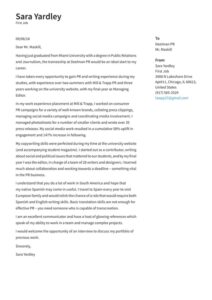
- **Your Contact Information:** Include your name, phone number, email, and LinkedIn profile link at the top.
- **Date:** The date you send the letter.
- **Hiring Manager’s Contact Information:** If known, address it directly to the hiring manager. If not, “Hiring Team” or “Hiring Manager” is acceptable.
- **Salutation:** Use “Dear Mr./Ms./Mx. [Last Name]” if possible.
- **Paragraph 1 (Introduction):** State position applying for, where you saw it, and brief enthusiasm.
- **Paragraphs 2-3 (Body):** Connect your skills, experiences (academic, volunteer, projects), and achievements to the job requirements. Use strong action verbs.
- **Paragraph 4 (Conclusion):** Reiterate interest, express eagerness for an interview, and thank them.
- **Closing:** “Sincerely” or “Best regards.”
- **Your Signature:** Followed by your typed name.
Remember, your cover letter is more than just a formality; it’s an opportunity to tell your unique story and demonstrate why you’re the ideal candidate for a particular role. By focusing on your transferable skills, showing genuine enthusiasm, and thoroughly researching the company, you can craft a compelling document that captures attention and opens doors to exciting career possibilities.
Embrace this chance to showcase your potential, your drive, and your readiness to contribute. With a thoughtful and well-structured cover letter, you’re not just applying for a job; you’re making a strong case for why you belong on their team and why they should invest in your future.